
No login needed · Personal records saved on this device only
About LGS
What is Lennox-Gastaut Syndrome?
LGS is tough. So are we! As you read about LGS, please remember that you are not alone.
Lennox-Gastaut Syndrome (LGS) is a severe epilepsy syndrome that develops in young children and often leads to lifelong disability.
Nobody is born with LGS. It develops over time. LGS is a rare disease (approximately one person in every 2,000).
While there is no cure for LGS, there is a hopeful path forward. On this site, you will find useful information and resources – and, most importantly, a community of support.
The 4 Core features of LGS
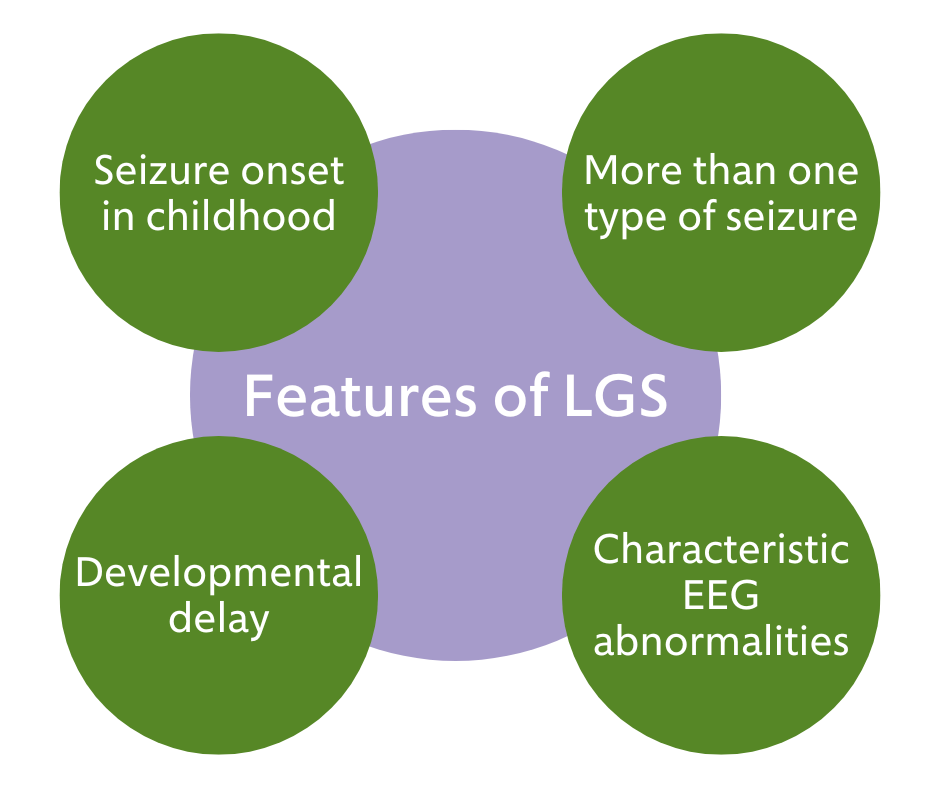
- Seizure onset in childhood
- More than one type of seizureSeizure Types Associated with LGS
- SSW & GPFA on the EEG Test
- Developmental delay*
30% of kids are typically developing at seizure onset but development becomes delayed when LGS begins.
LGS 101 for Newly Diagnosed Families
Other things to know about LGS
- The EEG test shows slow spike and wave (SSW) and Generalized Paroxysmal Fast Activity (GPFA), which occur in all with LGS.
- SSW and GPFA emerge over time from uncontrolled seizures.
- SSW and GPFA occur between seizures and can worsen seizures, development, sleep, and behavior problems. These EEG features are signs that brain development has been altered.
More About the Signs and Symptoms of LGS
- Seizures usually begin before age 5 years but can begin anytime in childhood.
- More than one seizure type is always present.
- Tonic seizures are present in all with LGS at some point.
- Seizures are nearly always treatment-resistant.
- Many LGS-associated disorders exist, including issues with sleep, behavior, movement, feeding, toileting, communication, and others.
Is there a cure for LGS?
- There is no cure for LGS.
- Seizures in LGS may go into remission, and may also recur.
What is likely to happen in the future for those with LGS?
- 30-50% of children with infantile spasms will develop LGS.
- 80-90% of children with LGS will continue to have seizures into adulthood.
- Over 95% with LGS are intellectually disabled.
- Up to 70% with LGS will no longer show slow spike-and-wave (<3Hz) on EEG in adulthood.
- Over 50% suffer behavioral issues including hyperactivity, sleep disturbances, rage attacks, aggression, and autistic features.
- Those with LGS are 14 times more likely to die prematurely. Premature death in LGS is often due to SUDEP*, aspiration pneumonia, seizures, injury, or the underlying brain disorder.
SUDEP – Sudden Unexpected Death in Epilepsy.
LGS Fact Sheet
Open LGS Fact Sheet in the appWhat causes seizures in LGS?
- Brain Injury During Early Life33%
- Abnormal Brain Formation in the Womb17%
- Genetic Factors15%
- Brain Infections15%
- Unknown10%
- Metabolic Disorders9%
- Immune Disorders<1%
- In LGS, the brain is affected at a critical time in its development. Seizures and developmental problems result.
- There are many causes of seizures that can evolve into LGS. In most but not all cases, a cause can be found. Finding it can take extensive testing. In some cases, more than one cause is found.
- Knowing the cause of seizures can help identify an effective treatment in some cases.
- Most with LGS may have abnormal brain imaging seen on the MRI test, but some have normal brain imaging prior to developing LGS.
- LGS can also develop from other epilepsy syndromes such as West, Ohtahara, EIEE, Hypothalamic Hamartoma, Infantile Spasms, etc.
Who has LGS?
- 1-2% of people with epilepsy
- 3-4% of children with epilepsy
- 48,000 children and adults in the U.S.
- 1,000,000 children and adults have LGS worldwide
Some genes and genomic regions that cause seizures that can evolve into LGS
as printed on the Fact Sheet
- GABRB3
- SCN1A
- SCN2A
- SCN8A
- CDKL5
- DNM1
- FOXG1
- STXBP1
- CHD2
- ALG13
- DOCK7
- FLNA
- GABRA1
- GLI3
- GNAO1
- GRIN1
- GRIN2A
- GRINBB
- HNRNPU
- KCNT1
- KCNQ2
- MAGI2
- MEF2C
- NEDDL4
- NDP NRXN1
- CACNA2D2
- CLN1/2/5
- ARX
- PCDH19
- SLC35A2
- PIGA
- SPTAN1
- PLCB1
- ST3GAL3
- PPP3CA
- PTEN
- TBD1D24 S
- CA2TCF4
- SCN1A
- TSC1/2
- SCN2A
- WWOX
- SCN8A
- Dup 15q
- SETBP1
- 22q Del
- SIK1
- Trisomy 21
- SLC25A22
- and many more . .
The LGS Foundation is committed to finding a cure for this devastating disorder!