
No login needed · Personal records saved on this device only
Caregiver Support
Care for the Caregiver
 Being a caregiver for a loved one with LGS is a commitment unlike any other. Caregiving requires limitless amounts of energy, empathy, and patience. While most caregivers will tell you that taking care of a loved one is a genuinely rewarding experience, it does come with a set of unique challenges. The emotional and physical demands involved with caregiving can strain even the most resilient person.
Whether you care for someone recently diagnosed with LGS, are adapting to new challenges as the disorder evolves, or have been living with LGS for a long time, the LGS Foundation is here to support you.
Care for the Caregiver
In coming to terms with a diagnosis of LGS, parents and caregivers may experience:
- Shock, denial, and disbelief
- Anger and rage
- Stress and depression
- Grief and fear – for your loved one or for the family as a whole
- Acceptance and adjustment – the realization that a lot can be done to improve the situation
- Fight and hope – the optimism that comes from dealing with challenges and seeing positive progress in your loved one. Your culture and your religion or beliefs background also may be a source of support for you at this time.
Following a loved one’s diagnosis, it is important for caregivers to talk about feelings and emotions with trusted people. They can be supported by family, friends, professionals, or other caregivers in the same situation. Managing the daily care of your loved one is very demanding. It can have an impact on your relationships with your partner, other family members, and friends.
Understanding the Emotional Journey of Families
What you experience as a caregiver will change over time. Depending on your age, your own personal situation, and your relationship with your loved one, your experiences will be unique. However, you are not alone!
The most important thing to remember is that the person you are taking care of is only as good as you are; if you do not take care of yourself, you will not be able to take care of your loved one.
 Watch Understanding the Emotional Journey of Families ↗
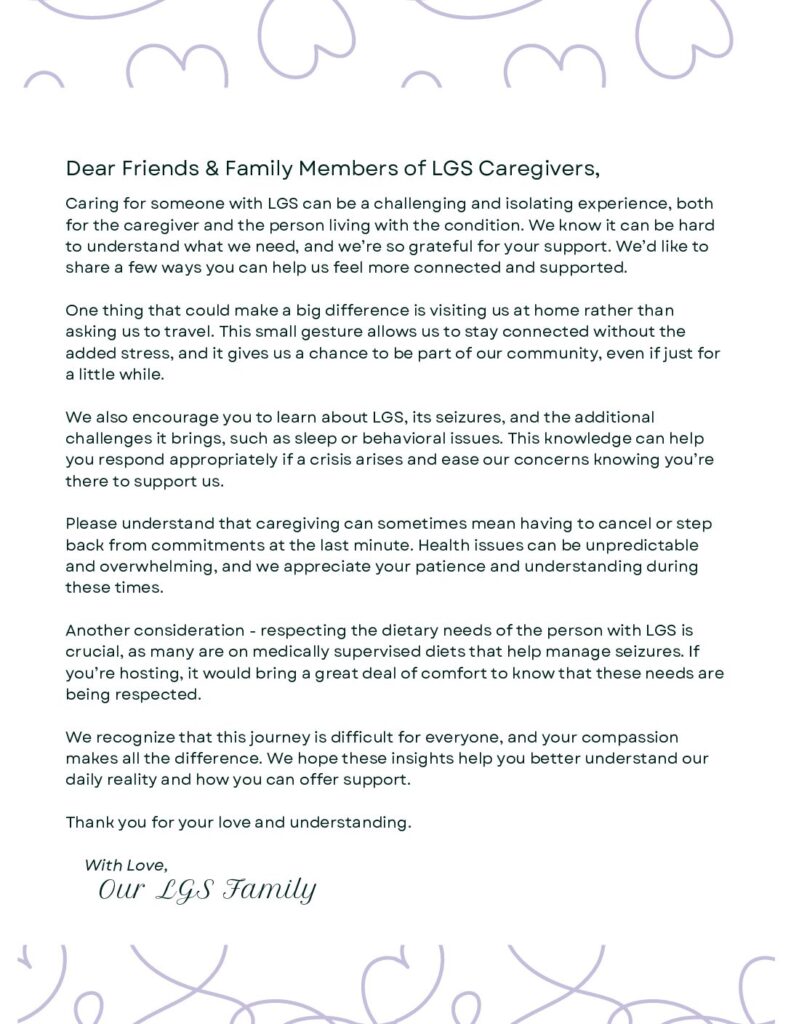
Are you a family member or friend looking for ways to support a family you know and love? This letter is written for you. This heartfelt letter is an expression of how LGS impacts our daily lives and the hope is you gain a better understanding of how important your support is along the LGS journey.
Taking Care of the Whole Family
There are many things you can do to cope with stress:
 Take a break to recharge yourself or ask for help.
- Give yourself time each day — 10 minutes or more — to do something you like.
- Set a limit on how much time you will spend looking or reading through the large quantity of information available to you.
- Don’t feel you have to handle everything at one time.
- Tell your loved one’s doctor how you are doing. Ask him or her to help you focus on what is most important.
- Share your feelings with your family, friends, other parents, doctors, and nurses.
- It's ok to ask for assistance when you feel you need help. Those who know and love us often times want to help but don't know how.
If you feel that you have reached a real crisis point, it may help to:
- Join a local support group or spend time with other caregivers who have loved ones with additional needs. They may have found ways of dealing with issues that you find particularly stressful.
- Call a support line. Many voluntary organizations provide a free helpline to assist you in getting through difficult times.
- Contact your doctor, who may provide contact details for your local counseling service.
Hear from Caregivers and Family Members about What it is Like Living with LGS:
Warning: Video content from a caregiver perspective, unedited and raw. Please know that content may trigger an unexpected emotional response.
 Watch Taking Care of the Whole Family ↗
Stress & Family Adjustment
Signs of Caregiver Stress
As a caregiver, you may be so focused on your loved one that you don’t realize that your own health and well-being are suffering.
Watch for these signs of caregiver stress:
- Feeling overwhelmed or constantly worried
- Feeling tired often
- Getting too much sleep or not enough sleep
- Gaining or losing weight
- Becoming easily irritated or angry
- Losing interest in activities you used to enjoy
- Feeling sad
- Having frequent headaches, bodily pain, or other physical problems
- Abusing alcohol or drugs, including prescription medications
Too much stress, especially over a long time, can harm your health. As a caregiver, you’re more likely to experience symptoms of depression or anxiety. In addition, you may not get enough sleep or physical activity or eat a balanced diet — which increases your risk of medical problems, such as heart disease and diabetes.
Watch Katherine Junger, Ph.D., Assistant Professor, UC Department of Pediatrics at Cincinnati Children’s Hospital, as she discusses the traumatic stress within the epilepsy community. Junger gives a detailed look into the signs and symptoms of caregiver fatigue, what to look for, and strategies to care for the caregiver.
 Watch Stress & Family Adjustment in LGS ↗
Read Post-Traumatic Stress Disorder (PTSD) in Parents of Medically Fragile Children ↗
Managing the Toll of Caregiving
Toll of Caregiver Trauma Series with Eileen Devine
Parents of children with chronic illnesses or disabilities are at a higher risk of parenting stress. Caregiving can put a physical and emotional strain on parents, as well as healthy siblings and even extended relations like grandparents. Taking care of a child with drug-resistant epilepsy is a high-risk factor for parenting stress.
This three-part series on the toll of caregiving in parents of children with medical issues was the result of a partnership with the Pediatric Epilepsy Surgery Alliance.
Navigating the Dynamics of Sibling Relationships
The challenge of supporting and parenting siblings of a child that requires constant supervision and care are many. How do you find balance for the entire family that provides an understanding of living with LGS and the need for different parenting techniques? Parenting in this situation often requires flexibility, compassion, and the ability to adjust expectations. It involves fostering an environment where all children feel valued and heard, while also recognizing the unique needs of each child. Eileen Devine takes a deep dive into this topic.

Managing Post-Traumatic Stress Before and After Pediatric Epilepsy Surgery
Dr. Brynn Huyssen is a clinical psychologist specializing in the assessment and treatment of post-traumatic stress. She has over 15 years of experience providing evidence-based treatments for trauma to adults and adolescents in hospitals and outpatient clinics. Dr. Huyssen has traveled extensively to train doctors and nurses around the world on how to support patients following trauma exposure and grief, and how to promote resilience. She also serves as a consultant to organizations that are working to become more trauma-informed.
Dr. Huyssen’s most important role, however, is being a mom to a child with catastrophic epilepsy. Through her son’s many hospitalizations and brain surgeries to stop seizures, she has had to implement the methods she teaches others, with unique and personal insight into the psychological and emotional impact of epilepsy surgery on children and their family members.
Supplemental materials provided by Dr. Huyssen can be found here. ↗
 Watch Managing Post-Traumatic Stress Before and After Pediatric Epilepsy Surgery ↗
 ↗“There is hope. And there are so many people out there who are working through the same thing, who can identify with what you’re going through, and who can offer support and encouragement to you. So just keep pressing on. You’re doing great.”
—Darla, Mother to Aaron